In brief
- 01Figure comes from unusual growth: burls, forks and rippled grain.
- 02The leaves are small, brittle and rarely flat, so pressing needs care.
- 03Use figure where it is seen up close, and approve the actual leaves.
Burl, crotch and figured veneers are leaves cut from unusual growth in a tree rather than from its straight, clear trunk. Burls show clusters of tiny knots, crotches show a feather or flame where a branch meets the trunk, and figures such as fiddleback and quilted ripple across the grain. They are among the most striking surfaces wood can offer, and the most demanding to work.
What is burl veneer?
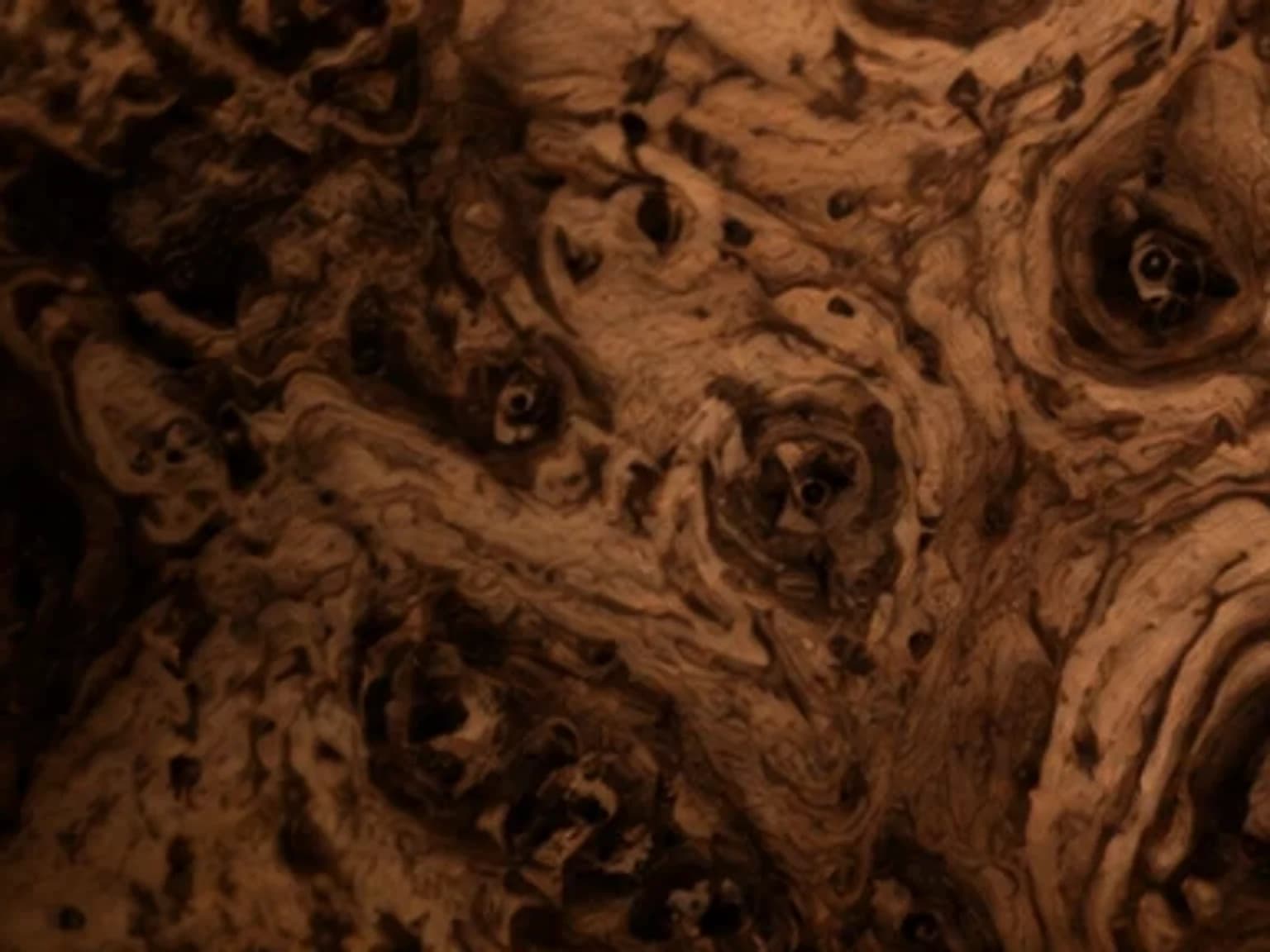
A burl is a rounded outgrowth on a trunk or root. It forms when a tree responds to stress, such as injury or infection, by producing a dense mass of tangled wood. Sliced into veneer, it shows swirling grain packed with small eyes, each one the trace of a dormant bud. Walnut and maple burls are among the best known. No two burls look alike, and even consecutive leaves from the same burl can differ noticeably.
What is crotch veneer?
Crotch veneer is cut from the point where a tree forks, or where a large branch joins the trunk. Grain from two directions meets there and fans outward, giving a feather, plume or flame figure that usually rises up the centre of the leaf. Mahogany and walnut crotches are the classic examples, familiar from antique furniture.
Other figures: fiddleback, quilted and bird's eye
- Fiddleback, also called curly: fine, regular stripes running across the grain that seem to shimmer as you move past. Found in maple, sycamore and mahogany among others.
- Quilted: a rolling, blister-like pattern with a three-dimensional look, most often found in maple.
- Bird's eye: small, round, lustrous spots scattered over the leaf, found mainly in maple.
Where figured veneer suits
| Figure | Character | Often suits |
|---|---|---|
| Burl | Busy swirls and eyes, strongest at close range | Small panels, box and drawer fronts, inlays, a single feature panel |
| Crotch | A central flame or feather with a clear direction | Door fronts, headboards, framed or centred panels |
| Fiddleback | Fine stripes that catch the light | Larger panels where a calmer figure is wanted |
| Quilted and bird's eye | A rippled or spotted surface | Feature furniture and accents |
As a rule, the louder the figure, the smaller the area it should cover. A single burl panel set into plain walnut often does more for a room than a wall of burl, and a crotch leaf is at its best when its flame is centred and framed.
Handling cautions
The twisted grain that makes these leaves beautiful also makes them fragile. They need more care at every stage, from storage to the final coat of polish.
- They are rarely flat. Burl and crotch leaves arrive buckled and are usually softened and pressed flat before gluing. Forced into a press while dry and wavy, they can crack or shatter.
- They are brittle. Support leaves flat when you move them, never lift them by a corner, and keep them in their bundle until they are used.
- Burls have natural holes. Each eye can leave a small gap, which is normally filled before or during pressing.
- Crotch is unstable. Leaves cut from a fork should be pressed onto their board without long delays, and kept away from big swings in humidity.
- Sand with care. The grain runs in every direction, so fine abrasives and a light hand help prevent tear-out and sand-through.
Matching figured veneer
Burl and crotch leaves are generally smaller than plain veneer, so a larger surface is built up from several of them. Book-matching mirrors neighbouring leaves side to side. End matching, sometimes called book-and-butt or four-way matching, also mirrors them top to bottom, which makes good use of short leaves and can turn a burl or crotch into a striking symmetrical pattern. Because each leaf is so individual, the leaves must stay in sequence from the bundle, and the layup should be agreed before anything is cut.
Finishing figured veneer
Figure changes more under a finish than plain grain does. A clear polish or lacquer deepens the colour and brings out the shimmer in fiddleback and quilted leaves, while a raw burl can look flat and dusty until it is finished. That makes an unfinished sample a poor guide. Ask to see a finished piece, look at it from several angles, since much of the figure moves with the light, and agree the sheen before the polisher starts.
Common questions
- What is burl veneer?
- Burl veneer is cut from a burl, a rounded outgrowth on a tree trunk or root that forms when the tree reacts to stress such as injury or infection. The tangled growth gives a swirling grain packed with small eyes, each the trace of a dormant bud. It is prized for furniture, panels and inlay, but the leaves are small, brittle and need careful flattening before pressing.
- What is the difference between burl and crotch veneer?
- Burl veneer comes from an abnormal outgrowth on the tree and shows a swirling, eyed pattern with no clear direction. Crotch veneer comes from the fork where a branch meets the trunk, and shows a feather or flame figure that runs up the leaf. Burl suits small, busy accents; crotch suits framed or centred panels where its direction can be used.
- Is burl veneer hard to work with?
- Yes, it needs more care than plain veneer. Burl leaves are rarely flat, are brittle because of their twisted grain, and contain small natural holes. They are usually softened and flattened before gluing, the holes are filled, and sanding is done lightly with fine abrasives. An experienced presser and polisher matter more with burl than with almost any other veneer.
- Where should figured veneer be used?
- Figured veneer works best where it is seen up close and over modest areas: door and drawer fronts, headboards, table tops, panels set into plainer joinery and small statement pieces. Across an entire wall, a strong figure can overwhelm a room. A common approach is to frame one figured panel with a calmer veneer of the same species.