In brief
- 01The cut decides the figure as much as the species does.
- 02Crown cut gives cathedral arches; quarter cut gives tight, straight lines.
- 03Rotary cut is the most economical and is often used for plywood faces and cores.
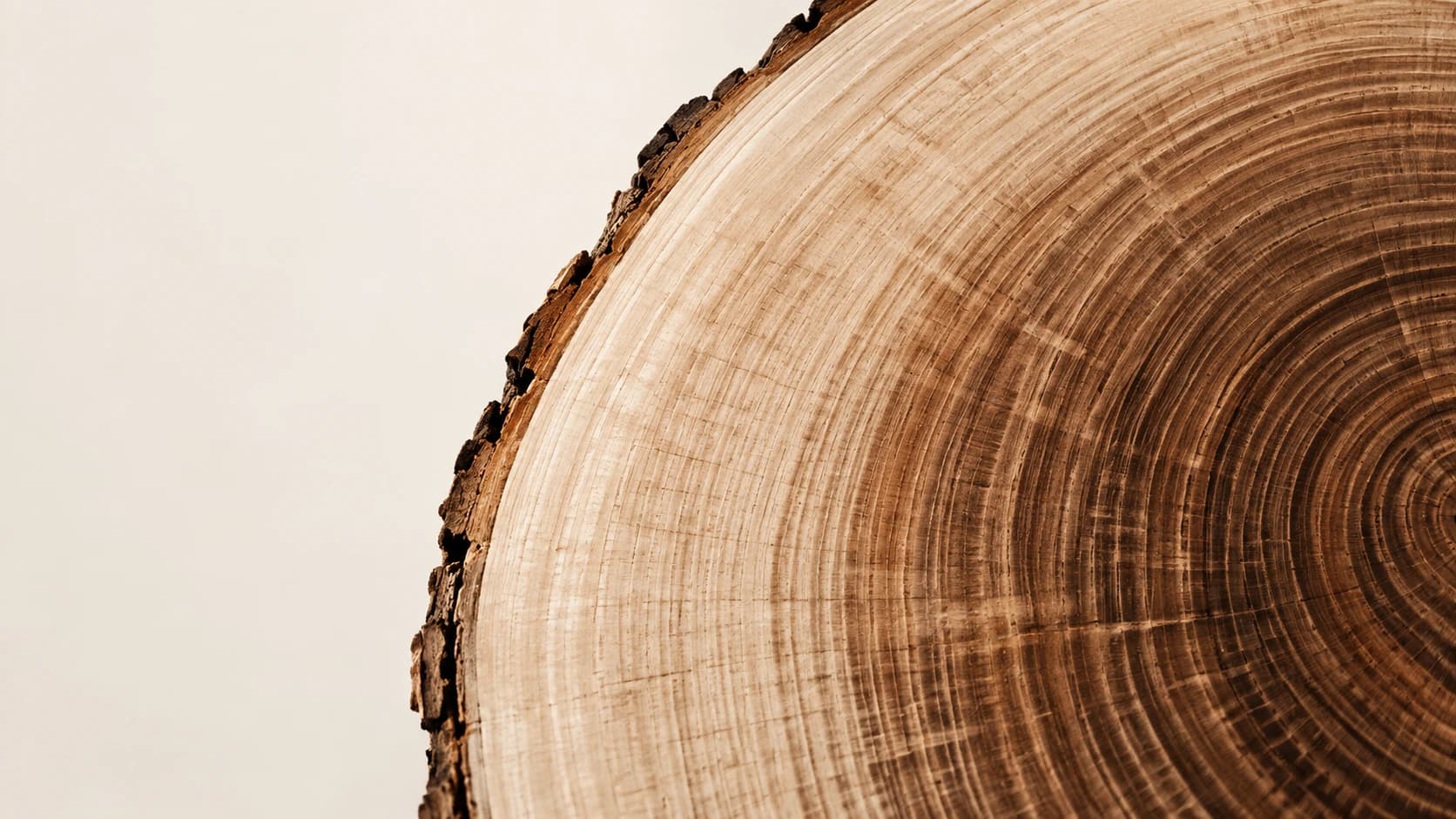
A veneer leaf is a thin slice of a log. What most people do not realise is that the angle of that slice matters almost as much as the tree it came from. Cut the same log three ways and you get three different surfaces.
Rotary cut
The log is turned against a fixed blade, like unrolling a paper towel. The result is a wide, continuous sheet with a broad, wandering grain. It is the most efficient use of the log, which is why rotary-cut leaves are common on plywood faces and inside the core itself.
Crown cut
The log is sliced flat, parallel to its centre. Growth rings show as arches, often called cathedrals, down the middle of each leaf, with straighter grain toward the edges. This is the figure most people picture when they think of a classic wood panel.
Quarter cut
The log is first split into quarters, then sliced at roughly a right angle to the growth rings. The grain runs in tight, straight, even lines. In species such as oak, this cut can also reveal a flecked pattern called ray figure.