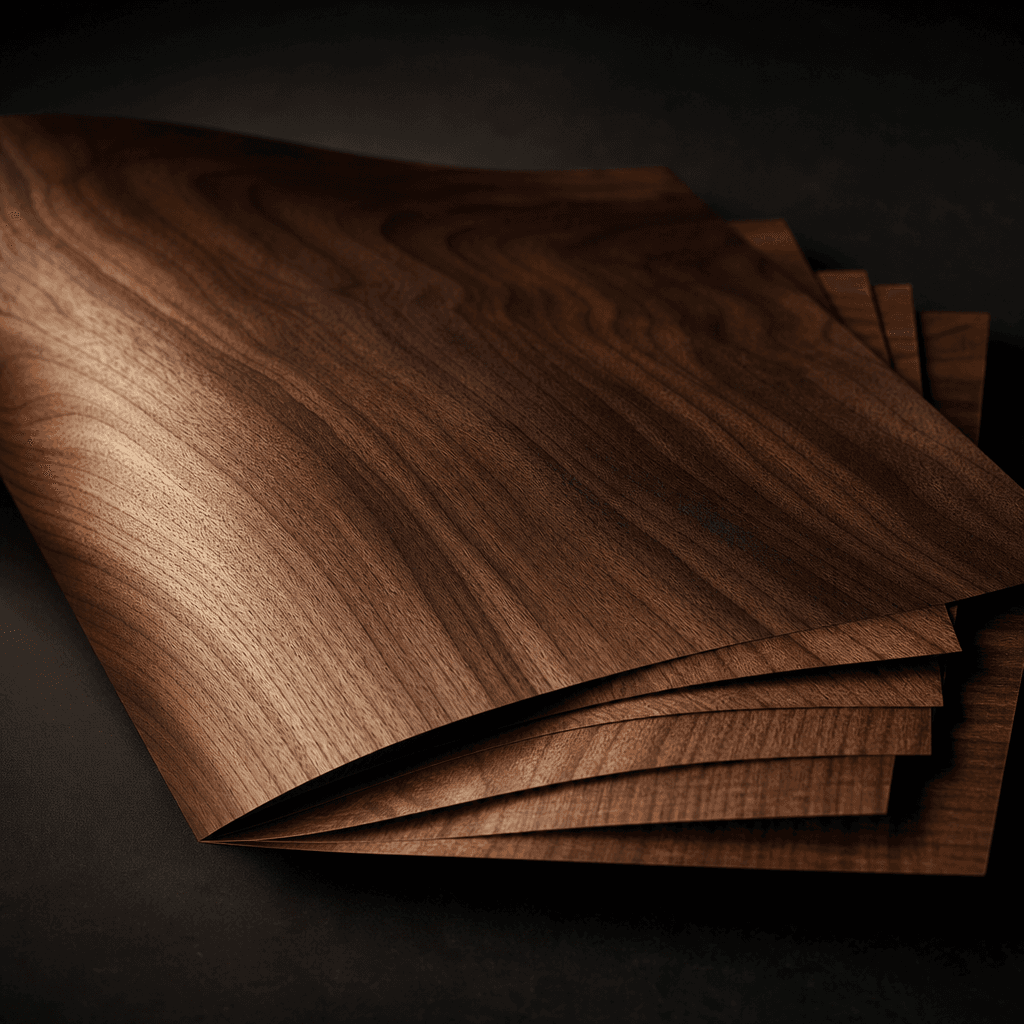
In brief
- 01Book-match mirrors each leaf against the next, for symmetry.
- 02Slip-match repeats leaves side by side, for a calmer, even rhythm.
- 03On large runs, approve a layup plan before anything is pressed.
Leaves come off a log in order, like pages in a book, and we keep them in that order. How those consecutive leaves are placed side by side on a panel is called the match. It is one of the quietest decisions in a project, and one of the most visible once the wall is up.
Book-match
Every second leaf is turned over, so neighbouring leaves mirror each other along the joint, like the two pages of an open book. The grain reflects across each seam and builds a symmetrical pattern. Because alternate leaves show opposite faces, they can catch light slightly differently, which gives a gentle light-and-dark rhythm sometimes called barber-poling.
Slip-match
Leaves are slid across in sequence without flipping, so every leaf shows the same face. The grain steps along the panel instead of mirroring. The look is more uniform, and it avoids the alternating sheen of book-matching, which is why it suits quarter-cut and straight-grained stock.
Choosing between them
- Book-match for figured, cathedral or flowing grain, where symmetry is the feature.
- Slip-match for straight, even grain, where consistency matters more than mirroring.
- For a wall of several panels, decide the match across panels as well as within them.